Categories
Women's Suffrage

Ruza Wenclawska: Suffragist, Labor Organizer, Poet and Actor

Rose Winslow [Ruza Wenclawska] photo from the Library of Congress. Originally published in The Suffragist, 1916.

Note: Ruza Wenclawska used different names in various aspects of her professional life, including Rose Winslow, Ruza Wenclaw, and Ruza Wenclawska. I’ll use the name, Ruza Wenclawska, for simplicity, with some notes to make clear when she used a different name.

Ruza Wenclawska was born December 15, 1889 in Suwalki, Poland. Her father, John Winslow was Lithuanian, and her mother Blanche was Polish. One of eleven children, her family immigrated to the United States when she was eight months old. The family name was most likely originally Wenclaw, but they Americanized it to Winslow sometime after their arrival in the United States. Wenclawska used the name Rose Winslow in her early life and during her time as a labor activist and suffragist.

Her family first lived in Pittsburgh, then in Shenandoah, Pennsylvania where her father worked in the mines. They moved to Philadelphia about 1895, where Wenclawska began working in a hosiery factory at age 11. She worked in the factory until about age 18, when she was diagnosed with tuberculosis and was admitted to a sanitarium. Several other members of her family also had tuberculosis, including her mother, and an older brother and sister, who both died in tuberculosis hospitals. Sometime after her release from the sanitarium she made an emotional appeal in a speech at a fundraiser for tuberculosis relief in Philadelphia, bringing her to the attention of the Philadelphia Consumer League, which hired her as a factory inspector.

By 1910 she was in New York City, where she worked as a labor activist and became a member of the Womens’ Trade Union League in 1913. She is mentioned by the New York Tribune as one of the labor activists organizing a garment workers strike in January 1913, in charge of the Union Hall at 177 East Broadway, giving out sandwiches provided by a local women’s suffrage organization.

She became a popular and fiery speaker on labor rights and suffrage, known for her down to earth speaking style. Her fame as an orator grew throughout 1913; she spoke at New York’s Cooper Union in April, addressed the National American Woman Suffrage Association in November, and spoke at hearings in both the Pennsylvania General Assembly and the United States House of Representatives.

Her speech on suffrage and working women to NAWSA brought her to the attention of the Congressional Union for Woman Suffrage, which hired her as an organizer. In March 1914 she was part of a delegation of working women who marched to the White House to meet with Woodrow Wilson, and was one of the four women chosen to speak to the President. In September 1914 she and Lucy Burns traveled to California to set up a Congressional Union headquarters in San Francisco. She spoke in cities throughout California on suffrage and working women, encouraging women to join the Congressional Union.

In 1915 she was one of the speakers on the suffrage Justice Bell tour of Pennsylvania. In 1916 she was one of the speakers sent by the National Woman’s Party to support Inez Milholland’s tour of the western states. Winslow spoke throughout Arizona, taking over Inez Milholland’s stop in Phoenix after she collapsed in Los Angeles. Winslow also became ill on the tour and canceled two appearances. Despite being told by a doctor to rest more and limit herself to speaking once a day, she sometimes spoke for two to three hours at a time.

In 1917 she was one of the suffragists arrested for picketing the White House and sentenced to 7 months in jail. With Alice Paul, she led a hunger strike and was forcibly fed. Her letters describing her treatment in jail were smuggled to her husband and are reprinted in Doris Stevens’ “Jailed for Freedom.”
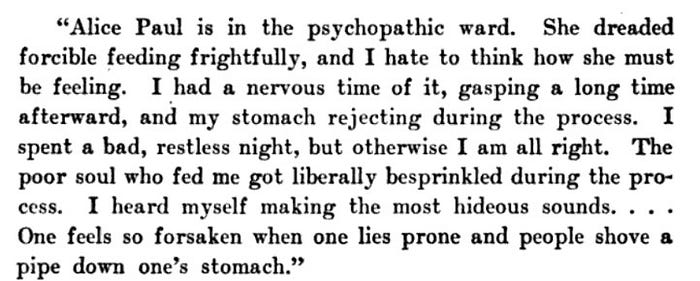
Alice Paul is in the psychopathic ward. She dreaded forcible feeding frightfully, and I hate to think how she must be feeling. I had a nervous time of it, gasping a long time afterward, and my stomach rejecting during the process. I spent a bad, restless night, but otherwise I am all right. The poor soul who fed me got liberally besprinkled during the proI heard myself making the most hideous sounds. . . One feels so forsaken when one lies prone and people shove a pipe down one’s stomach.
Wenclawska’s description of being force fed in prison. From Doris Stevens. Jailed for Freedom (1920) p. 189

Wenclawska married Phillip “Phil” Lyons, sometime before 1910. According to newspaper accounts, they met when he stopped to listen to one of her street corner speeches in New York and was enlisted to carry the soap box she stood on. Lyons, raised in Philadelphia, was also from an immigrant family. He was one of the officers of a New York company that sold loose-leaf binders, though he is remembered in the memoir of artist Guy Pène du Bois as an “amateur painter and dandy.” Wenclawska and her husband lived at several addresses in Greenwich Village, including 37 Bank Street, where they were part of the Village’s radical bohemian community.

The Orator — All day she hoards her strength, so that when night comes she may spread wide burnished wings and free, for the span of a midge’s life, that which faintly stirs imprisoned in the human breast.
The Orator, published under the name Ruza Wenclaw in The Masses, April 1917, p. 41.

Around 1917 Wenclawska started to publish poetry and work as an actor in New York. She used the name Ruza Wenclaw as an actress and poet. She published at least seven poems in 1916 and 1917. Her most reprinted poem The New Freedom for Women, was originally published in The Suffragist but most of her published poetry appeared in The Masses, the radical magazine published in Greenwich Village by Max Eastman.

While living in the Village, Wenclawska began a career as an actress. She appeared primarily in productions by the Provincetown Players, the Greenwich Village theater company that launched the careers of Susan Glaspell and Eugene O’Neill. Her husband Phil Lyons also occasionally played small parts. She appeared in 5050 in January 1918 and The Rescue in December 1918 with the Provincetown Players. She appeared on Broadway at the Plymouth Theater in Redemption, starring John Barrymore, in October 1918.

In 1921 she went to Europe to join her husband, who had gone to England, France, and Italy, ostensibly as a sales trip for his company. According to her passport application she planned to visit Britain, France, Italy, Switzerland and Gibraltar to work and study.

In 1924 she began using her full name, Ruza Wenclawska, professionally and that is how she is billed for the rest of her career. In that year she appeared with the Provincetown Players in The Spook Sonata in January 1924 and Fashion in February 1924.

A playbill for the Provincetown Players Production of “Fashion” in 1924. It is printed in a deliberatly old-fashioned style.
Playbill for the Provincetown Players 1924 production of “Fashion” with Ruza Wenclawska as Prudence.

Her final role was a small part in the premier of Eugene O’Neill’s Desire Under the Elms. The Provincetown Players production opened November 11, 1924, when it transferred to Broadway in 1925 Wenclawska remained with the show.

Sometime in 1925 she made another trip to Europe, returning in December 1925 with her husband, but their marriage was soon to end in divorce. By September 1926 Phil Lyons was back in Paris and engaged to a publisher’s daughter from Chicago he met while studying art.

In the 1930 census Ruza Wenclawska is listed as a patient at the Central Islip State Hospital. Records of New York state hospitals are not publicly available, but probably the illness which had forced her to quit factory work as a teenager finally caught up with her and she was in the hospital’s tuberculosis ward. She died on April 16, 1934 in Islip, New York.

Notes: I started researching Ruza Wenclawska after I saw the musical Suffs in New York. I googled all the suffragists I hadn’t heard of before, and was very disappointed with the limited information on Wenclawska, especially the fact that no one seemed to be sure when she died. This short bio is the result of my research so far.

Wenclawska discusses her early life in a speech reported in: Stirring Scenes as New Liberty Bell Tours the Valley, The Pittston Gazette, Sept. 11, 1915, p. 6. Also: Miss Winslow on the Issue of Suffrage, The New Castle Herald, Aug. 17, 1915, p.10.

Census records:

1900 US Federal Census, Philadelphia Ward 32, as Rosa Vamslow

1910 US Federal Census, Manhattan Ward 22, New York as Rose W. Lyons

1920 US Federal Census, Manhattan Assembly District 10, New York as Rose Lyons

1925 New York State Census, New York as Ruza Wenclawska

1930 US Federal Census, Islip, New York as Ruza Wenclawska

Directories: 1917 New York City directory available on ancestry.com as Rose Winslow

Passport application: 1921, available on ancestry.com an familysearch.org as Ruza Lyons

Proud Girl Strikers Reject Philanthropy, The New York Tribune, Jan. 18, 1913, p. 6.

Cupid of the Cause Lurks in Soapbox, The New York Tribune (October 1, 1913) p. 10

Annual report of the Cooper Union for the Advancement of Science and Art, June 1914, p. 105

Information on Provincetown Players including cast lists for productions: Helen Deutsch & Stella Hanau. The Provincetown: A Story of the Theatre, Farrar and Rinehart, 1931.

Cast list for Desire Under the Elms from The Billboard, Aug. 14 1926, p. 61 https://hdl.handle.net/2027/iau.31858030435931

Phil Lyons’ engagement is in The Chicago Tribune, Sept. 19, 1926, pt. 2, p. 4.

Death: New York Death Index 1934 https://archive.org/details/New_York_State_Death_Index_1934/page/n1246/mode/1up

Poetry:

The New Freedom for Women, The Suffragist (September 30, 1916), p. 4

Fire-Bird, The Masses (October 1916), p. 9

The Orator, The Masses (April 1917), p. 41

Children Playing, The Masses (April 1917), p. 42

Regret, The Masses (June 1917), p. 50

Hills, The Masses (July 1917), p. 3

The Mountains, The Masses (April 1917), p. 25

This article was originally published on Medium.com

Categories
Women's Suffrage

Biographical sketches of suffragists

I’ve written short biographies of women involved in the suffrage movement for the Online Biographical Dictionary of the Woman Suffrage Movement in the United States. I’ll have more published in December 2024.

Categories
Delaware History Women's Suffrage

Delaware’s silent sentinels: Delaware women in the fight for women’s suffrage

In a previous post, I covered the role of Delaware women in the struggle to ratify the 19th Amendment to the Constitution, granting women the right to vote. Women from Delaware also played an important part in the long and difficult struggle to get the amendment proposed and passed by Congress. The National Woman’s Party, founded in 1916, was a women’s rights group that used more militant tactics to get the attention of politicians and the public.

Delaware’s Mabel Vernon marches to the White House

One of the leaders of the NWP was Delawarean Mabel Vernon. Born in Wilmington in 1883, her father was a newspaper editor. She attended Swarthmore College, where she met Alice Paul, who would become the leader of the NWP. After college Vernon worked as a teacher until Paul asked her to work as an organizer for the Congressional Union for Woman Suffrage and NWP. She organized local protests and nationwide tours and became an accomplished speaker. In 1916 she led a group of activists who unfurled a banner and heckled President Wilson during a speech to Congress.

A policewoman (in white) arrests Delawarean Annie Arniel (center left) for picketing the
White House

In 1917, the NWP decided to step up pressure on President Wilson and organized pickets in front of the White House. Calling themselves “silent sentinels” the women picketed the White House, in Lafayette Park and at other government buildings. In June 1917 the police began arresting picketers. Initially they were usually released without charge, but when the protests continued the penalties became more serious. Alice Paul and other women were sentenced to up to 6 months in Occoquan Workhouse. Some prisoners held hunger strikes and were force-fed by prison authorities. Released prisoners were sent on nationwide tours by the NWP and spoke to crowds wearing their prison uniforms.

Catherine Boyle, of New Castle, Delaware, holds a suffrage flag

A number of Delaware women were among the protesters. Seven served jail time: Mabel Vernon, Florence Bayard Hilles, Annie J. Magee, Naomi Barrett, Annie Arniel, Catherine Boyle, and Mary Brown. Annie Arniel of Wilmington, who had worked in a munitions factory, spent the most time in jail. She was arrested 8 times and spent a total of 103 days in jail. After one of her arrests Arniel told the Sunday Star, a Wilmington paper,

We were good enough to work in the steel plant and help load shells for the battle-fields of France, but we are still not good enough to vote, it seems. Can anyone see justice in this?

The National Woman’s Party continued the protests until 1919 when Congress passed the 19th Amendment.

Photo credits: Photographs from the Records of the National Woman’s Party. Library of Congress and Library of Congress, Prints and Photographs Division.

For more information see:

Ford, Linda G. Iron-Jawed Angels: The Suffrage Militancy of the National Woman’s Party, 1912-1920. University Press of America, 1991.

Mabel Vernon: Speaker for Suffrage and Petitioner for Peace. Interview by Amelia R. Fry. Bancroft Library. Suffragists Oral History Project.

Stevens, Doris. Jailed for Freedom. Boni and Liveright, 1920.

Women of Protest: Photographs from the Records of the National Woman’s Party. Library of Congress.

Originally published: 2012

Categories
Delaware History Women's Suffrage

The 19th Amendment in Delaware

After years of struggle by women’s movement advocates to gain the vote for women, the United States Congress passed the 19th Amendment granting women the right to vote in 1919. However, the amendment would not become part of the Constitution until it had been ratified by 36 states. Ten months later 35 states had ratified the amendment and only one more state was needed. The leaders of the women’s suffrage movement looked to the Delaware General Assembly to cast the decisive vote at a special session in March 1920.

The suffrage and anti-suffrage forces descended on Dover to encourage the General Assembly to vote their way, marching through town wearing distinctive flowers, yellow for the suffragists and red for the anti-suffragists. Both sides were led by charismatic women.

The leaders of the suffrage forces were Florence Bayard Hilles of the National Woman’s Party and Mabel Lloyd Ridgely of the Delaware Equal Suffrage Association. Florence Bayard Hilles was the daughter of the American ambassador to Great Britain and was descended from Delaware’s politically prominent Bayard family. Mabel Lloyd Ridgely was the leader of the Kent County suffragists and also came from a prominent Delaware family.

The anti-suffrage leaders were two equally prominent Delaware women. Mary Wilson Thompson was active in many civic causes and was an expert lobbyist. She was eventually known in Delaware for, among other things, founding the Delaware Mosquito Control Corp which worked to reduce mosquitoes in Sussex County. Emily Bissell was a social reformer who founded what is today West End Neighborhood House and is best known for introducing Christmas Seals to America.

Mary Wilson Thompson, leader of the Delaware anti-suffragists

Both sides lobbied and protested in Dover. The suffragists brought Eamon de Valera, president of the Irish Free State to Delaware to convince Irish-American representatives and at one point resorted to kidnapping the chairman of a House committee so that he couldn’t present the amendment for a vote the suffragists were sure to lose.

On May 5th the Delaware Senate ratified the amendment. Only the House remained to be convinced. After months of lobbying and rallying by both sides the Delaware House on June 3rd voted to adjourn without passing the amendment. The anti-suffragists had won.

But their victory was short-lived. Delaware had lost its chance to make history and the lobbying and marching passed to the next state, Tennessee, which ratified the amendment by one vote. The Nineteenth Amendment and votes for women became part of the Constitution.

Photo sources:
Florence Bayard Hilles. Photographs from the Records of the National Woman’s Party. Library of Congress.

Mary Wilson Thompson. Historical Society of Delaware.

For more information see:
de Vou, Mary R., “The Woman Suffrage Movement in Delaware,” in H. Clay Reed, ed., Delaware: A History of the First State (New York: 1947), 1:349-70.

“Delaware,” in Ida Husted Harper, ed., The History of Woman Suffrage (National American Woman Suffrage Association: 1922) 6: 86-103

Higgins, Anthony, ed., “Mary Wilson Thompson Memoir,” Delaware History 18 (1978-79): 43-62, 126-152, 194-218, 238-266.

Hoffecker, Carol E., “Delaware’s Woman Suffrage Campaign,” Delaware History 20 (1982-83): 149-167.

Votes for Delaware Women: A Centennial Exhibition. University of Delaware.

Categories
Delaware History

Another manner of treason: The trial and execution of Catherine Bevan in New Castle, Delaware

On September 10, 1731, in New Castle, Delaware, 50 year old Catherine Bevan and Peter Murphy, a young servant, were executed for the murder of Catherine’s husband Henry Bevan. Peter was hanged, but Catherine had been sentenced to death by burning. The executioner had planned to hang her over the fire so that she would be strangled to death before the flames reached her, but he had never executed someone by burning before and lit the fire too soon. The flames leapt up, burning the rope around her neck so that she fell alive into the fire and was burned to death.

A description of petty treason from Conductor Generalis, an 18th century manual for justices of the peace in the American colonies.
A description of petty treason from Conductor Generalis, an 18th century manual for justices of the peace in the American colonies.

The murder had happened in June of 1731. Henry Bevan had complained to neighbors that his wife and servant mistreated him and the neighbors gossiped about Catherine and Peter’s relationship. When Henry died suddenly and was nailed into his coffin before anyone could view the body, the local magistrate became suspicious and had it pried open. The body was covered in bruises. Catherine and Peter were brought in for questioning and Peter quickly confessed. He said they had first tried to poison Henry by spiking his wine with sulfuric acid. When that didn’t work, Peter beat him until he was weak enough for Catherine to strangle with a handkerchief. Peter changed his story on the scaffold, saying that Catherine hadn’t taken part in the murder, but that it had been her idea. Catherine steadfastly denied everything, even at her execution.

Catherine Bevan was the only woman executed by burning in Delaware and the only woman ever burned for murdering her husband in colonial America. But why was Catherine Bevan burned while her co-defendant was hanged. And how common was execution by burning in colonial America?

Both Bevan and Murphy were convicted of petty treason, a crime brought to the American colonies from English law. The English Treason Act of 1351 (25 Edw. III St. 5 c.2.), besides the usual forms of treason like adhering to the King’s enemies, also defined “another manner of treason,” murdering someone to whom, in medieval society, you owed obedience. The 1351 Act named three types of murder that qualified as petty treason: a servant slaying his master, a wife slaying her husband, or a man secular or religious slaying his prelate. Petty treason was originally punished the same as treason. A convicted man was hanged, drawn and quartered, while a woman was burned to death. Eventually hanging, drawing and quartering was considered too cruel and the punishment for men was changed to hanging, but the punishment for women remained burning.

The English colonies in North America for the most part adopted English laws on petty treason. Delaware is a good example of how this worked. In 1719 the Delaware General Assembly passed a law providing that all capital crimes in Delaware were to be tried and punished the same as in England (1 Del. Laws 64). The law was somewhat confusingly worded and in 1741, ten years after Catherine Bevan’s execution, a supplemental act was passed to clarify “That every person or persons, who shall be guilty of any petty-treason, misprision of treason, murder, manslaughter, homicide, bestiality, incest or bigamy, shall be tried in like manner as other felons by the said act are directed to be tried, and punished in the like manner as persons guilty of the like crimes and offences are punishable by the laws and statutes of that part of Great Britain called England.” (1 Del. Laws 225)

Other colonies adopted burning as a punishment for petty treason as well, but it was not always applied. At least two other women in colonial America were executed for murdering their husbands, but were hanged not burned. In 1644 a Maine woman named Cornish was hanged for murdering her husband and in 1708 Connecticut hanged Abigail Thompson for the murder of her husband. There is very little information available about the 1644 Maine case. As far as I can tell, Connecticut never adopted English criminal law as a whole and had no laws on petty treason, which may account for the punishment in that case.

By far the women most commonly convicted and burned for petty treason in the North American colonies and the early United States were those falling into the first category of petty treason, “a servant slaying his master.” Enslaved women convicted of killing their owners, taking part in slave revolts, or committing arson were commonly executed by burning. I have been able to find mention of 24 women executed by burning in early America; 22 of them were enslaved women. Enslaved women were executed by burning in many states, New York, New Jersey, and Massachusetts as well as the South. The one other woman executed by burning in colonial America was a white servant in Maryland, who assisted her fellow servants in killing their employer.

The Delaware law passed June 5, 1787 abolishing burning as a punishment for petty treason.

Catherine Bevan would be the only woman burned in Delaware. Nearly 60 years later, on April 15, 1787, a woman named Sarah Kirk, living in Christiana Hundred, struck her husband James in the head with a stone and then beat him to death with a stick. Not wanting to repeat the botched 1731 burning, the state moved relatively swiftly to change the law. On June 5, 1787 the General Assembly passed a law (2 Del. Laws 905) changing the punishment for petty treason to hanging, the same as for any other “felony of death.” Sarah Kirk’s trial was held on June 6th. She was found guilty of petty treason and sentenced to be hanged. In what may have been an excuse to make sure the new law had gone into effect before the trial, her attorney asked that her conviction be overturned because one of the jurors had not sworn the oath of fidelity to the state. The conviction was set aside and she was retried on October 5th, 1787. She was once again found guilty and sentenced “to be hanged by the neck until she be dead.” Sarah Kirk was executed in New Castle on October 12th where, according to a newspaper account, “she behaved with those sentiments of penitence and resignation, which became her unhappy situation.”

Judgment in the 1787 trial of Sarah Kirk for petty treason.

The punishment of petty treason by burning was abolished in England in 1790 and gradually abolished in the United States during the late 1700s and early 1800s. The specific crime of petty treason was also abolished and was treated as any other type of murder.

Sources:

David V. Baker, Women and Capital Punishment in the United States: An Analytical History. McFarland, 2015.
Ruth Campbell, Sentence of Death by Burning for Women, 5 J. Legal Hist. 44 (1984)
Matthew Lockwood. From Treason to Homicide: Changing Conceptions of the Law of Petty Treason in Early Modern England, 34 J. Legal Hist 31 (2013)
The records of the Catherine Bevan trial are unfortunately missing but the records from State v. Kirk are available at the Delaware Public Archives.
Pennsylvania Gazette (June 1731)
Pennsylvania Gazette (Sept. 23, 1731)

This article was originally published on the Delaware Law School Law Library blog, February 28, 2018.